Your Dollar Losses, Ranked: The Casino Games That Bareble Barely Cost You (and the Ones That Bleed You Dry)
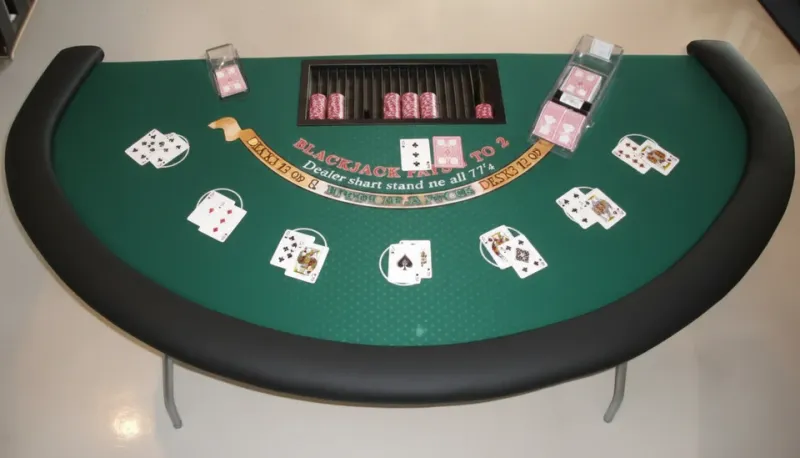
Photo: Binbin245, CC0, via Wikimedia Commons
Every game guide on the internet tells you to 'know the house edge.' Fine. But nobody ever tells you what that number feels like in your wallet.
So let's do the translation. House edge is the average cut the casino keeps from every dollar you put in action over time. A 1% edge means that for every $100 you wager — not deposit, wager, including every re-bet of your winnings — the house expects to keep about a buck. That's it. That's the whole concept. Now let's see who's charging fair prices and who's running a toll booth.
The Friendliest Games on the Floor
Blackjack (with basic strategy): ~50 cents per $100. Played correctly at typical rules, blackjack is the cheapest entertainment in the building. The catch is 'correctly' — every hand you play on gut feel instead of basic strategy pushes that number up fast. A pocket strategy card is legal almost everywhere and worth more than any slot tip you'll ever read.
Craps — pass/don't pass line: about $1.40 per $100. The line bets at the craps table are genuinely reasonable. The problem is everything else on that colorful layout. More on that below.
Baccarat — banker bet: roughly $1.06 per $100. No strategy required, no decisions after the deal. The banker bet is quietly one of the best deals in any casino, which is why high rollers crowd these tables.
Video poker (full-pay Jacks or Better): around 46 cents per $100. With perfect play on the right paytable. Notice the fine print — 'full-pay' machines are getting harder to find, and sloppy hold decisions can double your cost in a hurry.
European roulette: about $2.70 per $100. The single-zero wheel is tolerable. It's also increasingly rare in the US, which brings us to the trouble section.
The Ones Quietly Charging Ten Times More
American roulette: $5.26 per $100. That extra double-zero pocket doesn't look like much, but it nearly doubles the European wheel's price tag. Same game, same spinning ball, almost twice the cost.
Craps — the proposition bets in the middle: $9 to $16+ per $100. The hardways and one-roll props are the loudest, most celebrated bets on the table, and they're the worst money on the floor. The field bet at 12-to-3 pays? That's over $5 per $100 for a bet that feels generous.
Most penny slots: $8 to $15 per $100. Here's the industry's favorite sleight of hand. A penny slot with 12% house edge doesn't take 12 cents per spin — it takes 12 cents per $100 cycled through the machine. Bet $1.50 a spin at 600 spins an hour and you're putting $90,000 a year in action during a serious habit. The 'penny' label is marketing, not math.
Keno: $20 to $30 per $100. If you enjoy keno, enjoy it knowingly. It is, charitably, a very expensive lottery ticket with comfortable chairs.
What This Means for Your Next Session
Three takeaways worth remembering:
- Game choice is your biggest lever. The difference between blackjack and penny slots is roughly twenty times the cost for a similar amount of play. No bonus, promotion, or lucky streak closes a gap that wide.
- Within a game, bet placement matters almost as much. Craps players making line bets are playing a different financial sport than their neighbors throwing prop bets.
- Cheap games aren't winning games. Even at 50 cents per $100, the expectation still points the house's way. The goal of picking low-edge games isn't to beat the casino — it's to make your entertainment budget last dramatically longer while you try.
The flashy games are flashy for a reason: the lights and jackpots have to pay for themselves somehow, and that somehow is you. The boring tables in the corner, where dealers flip cards and nobody screams at a reel spin? That's where your $100 goes the distance.